• 103qo

    Wechat

  • 117kq

    MicroBlog

Empowering Lives, Healing Minds, Caring Always

Leave Your Message

Top Rehabilitation Therapy Research Tools for Buyers

Selecting the right tools can shape how rehabilitation studies are planned, measured, and reported. Rehabilitation Therapy Research may involve patient-reported outcomes, movement assessments, treatment records, and follow-up data. Each source brings different practical demands. A therapist recording walking speed in a clinic needs a clear protocol and dependable equipment. A research team reviewing published trials needs searchable databases and transparent screening methods. The tools should fit the research question, not merely offer the longest feature list.

Buyers can compare literature databases, assessment instruments, data-collection platforms, statistical software, and systems for managing study records. Check whether measures have relevant validation evidence, accessible guidance, and suitable language versions. For digital tools, examine data export options, access controls, and compatibility with existing workflows. Ask for a demonstration using a realistic task, such as entering a mobility score or retrieving a study record. Small details matter. No tool is perfect. Pricing, training needs, and technical support can change the total cost after purchase. Vendor claims deserve careful checking against documentation and independent evidence where available. Some useful information may be hard to compare across products, and buyers should acknowledge that uncertainty. A considered choice balances research needs, staff capacity, participant experience, and long-term reliability. This guide introduces key tool categories and practical questions to ask before committing.

Top Rehabilitation Therapy Research Tools for Buyers

Core Functions of Rehabilitation Therapy Research Tools

Top Rehabilitation Therapy Research Tools for Buyers
Core Functions of Rehabilitation Therapy Research Tools

A strong rehabilitation research tool should make patient progress easier to measure, not just easier to display. Look for repeatable assessments of gait speed, joint range, balance, pain, and daily-task performance. Clear timestamps and consistent scoring help teams compare sessions without relying on memory. Small details matter. A therapist should be able to see whether a change reflects real improvement or a different testing setup.

The World Health Organization estimated that 2.4 billion people could benefit from rehabilitation in 2019, nearly one in three worldwide. Its report, Global Estimates of the Need for Rehabilitation, underscores why scalable tracking and reporting matter. Useful platforms can organize outcomes over time, support care planning, and export data for research analysis. They should also document missing results and explain how measures were collected. A polished chart can still hide weak data. No dashboard fixes a rushed assessment. Buyers should test tools with realistic cases, including patients who miss visits or use assistive devices. Check access controls and consent workflows, too. These features are easy to overlook during a short product demonstration, and that is where my own evaluations can fall short.

Major Tool Categories and Their Clinical Applications

Rehabilitation research tools serve different clinical questions. Assessment instruments measure strength, balance, range of motion, or walking speed. A handheld dynamometer can record force during a knee extension test, while a timed walk test captures functional mobility. These measures help clinicians compare performance over time. Consistent setup matters: chair height, instructions, and rest periods can all affect results.

Motion sensors and video-based movement analysis can show how a patient walks, reaches, or transfers. Wearable sensors may track steps and movement outside the clinic, adding context to a brief appointment. But more data is not automatically better. Researchers should check sensor placement, recording duration, and missing data before interpreting patterns. A lopsided gait graph may reflect a real change—or a loose strap.

Therapeutic research tools include electrical stimulation units, balance platforms, and adjustable exercise equipment. They help teams study how specific tasks or treatment doses relate to outcomes. Patient-reported questionnaires add another view, such as pain during stairs or fatigue after a short walk. Choose tools that match the population and study question, then confirm staff training, accessibility, and maintenance needs. Small details count. Calibration can drift, and a questionnaire may miss what matters most to one patient. That deserves a second look.

Top Rehabilitation Therapy Research Tools for Buyers

Major tool category: timed, performance-based functional assessments

Clinical applications: The 6-Minute Walk Test (6MWT) and 2-Minute Walk Test (2MWT) assess walking capacity and functional endurance. The 30-Second Chair Stand Test assesses lower-body strength and functional mobility.

Bars show the fixed duration of each test protocol, not patient results or comparative effectiveness.

Key Features Buyers Should Compare

Buyers should compare measurement quality before interface polish. Can the tool track pain, mobility, balance, and daily function with validated measures? Does it support repeat testing and export raw results? The World Health Organization’s 2023 rehabilitation fact sheet estimates that 2.4 billion people could benefit from rehabilitation. That scale makes comparable, interpretable outcomes essential, not optional. Ask vendors for validation studies, target populations, and any limits on interpreting scores. A polished dashboard can still mislead.

Workflow matters too. Check whether clinicians can record a timed walk, range of motion, or patient-reported outcome without switching screens. Look for clear permissions, audit trails, accessible displays, and practical data export. The WHO’s 2022 Global report on health equity for persons with disabilities estimates that 1.3 billion people experience significant disability; tools should work for varied sensory, cognitive, and mobility needs. Small details matter. Test it live. Have staff enter a sample visit, correct an error, and retrieve the record. Then ask how missing data are handled. I would not assume a feature list proves usability; a short pilot may reveal awkward steps that a demo hides.

Assessing Evidence, Usability, and Integration Needs

Top Rehabilitation Therapy Research Tools for Buyers

Choosing a research tool means checking more than its feature list. Look for evidence that matches your setting, patient population, and clinical questions. A study involving a large hospital may not reflect a small outpatient team. Check how outcomes were measured, who participated, and whether results were independently evaluated. Promising results matter, but methods matter too. If key details are missing, treat strong claims cautiously.

Usability affects whether a tool becomes part of daily work. Ask clinicians to test common tasks, such as finding a study or recording an outcome, during a realistic session. Note confusing labels, extra clicks, and accessibility barriers. Small friction adds up. Integration deserves equal attention: confirm whether the tool can exchange data with existing systems, what staff training it requires, and how updates are handled. A polished demonstration can hide a messy workflow. I would not assume every team needs deep integration; sometimes a simple, reliable process is better.

Tips: Request a sample workflow and verify evidence references yourself. Test with the people who will use the tool. Record setup time and recurring tasks. Keep one concern on the list; a trial may reveal problems you did not anticipate.

Planning Procurement, Training, and Ongoing Support

Buying rehabilitation research tools is not just a hardware decision. It shapes the daily workflow. The World Health Organization’s 2022 Global Report on Assistive Technology estimates that 2.5 billion people need one or more assistive products. These products are not the same as therapy research tools, but the report highlights a useful procurement lesson: access depends on more than purchase price. Compare calibration needs, data export formats, cleaning routines, replacement parts, and fit with existing assessment spaces. Ask staff to test a typical session, from setup through data entry. Small details count.

Training belongs in the budget before delivery, not after the first problems appear. WHO’s 2023 rehabilitation fact sheet estimates that 2.4 billion people live with conditions that may benefit from rehabilitation. Consistent measurement matters at that scale. Specify onboarding for clinicians and researchers, refresher sessions, written protocols, and a named support contact. Check response times, software updates, warranty terms, and spare-part availability; request these details in writing. A short pilot may expose awkward steps, such as a slipping strap or a display that is hard to read under clinic lighting. We may still overlook something. Collect user feedback after the first month, then revise training and purchasing criteria before expanding the setup.

Top Rehabilitation Therapy Research Tools for Buyers - Planning Procurement, Training, and Ongoing Support

Research Tool Typical Measurements or Outputs Procurement Considerations Training to Plan Ongoing Support to Confirm
Handheld dynamometer Isometric force or strength measurements; results may be recorded in newtons or kilograms-force, depending on the device. Check measurement range, resolution, calibration guidance, mounting options, and suitability for the intended muscle groups and patient population. Standardized positioning, stabilization, test instructions, repeat trials, and consistent recording of units and test conditions. Calibration or verification procedures, battery replacement, repair options, and access to updated user instructions.
Goniometer or digital inclinometer Joint range of motion, generally reported in degrees. Compare measurement method, scale readability, device durability, cleaning compatibility, and whether digital data export is needed. Anatomical landmark identification, patient positioning, movement limits, and consistent measurement protocols. Cleaning guidance, replacement parts where applicable, and a process for checking measurement consistency.
Surface electromyography system Muscle electrical activity over time; signals are commonly analyzed for amplitude and timing. Assess channel count, sampling and filtering options, electrode compatibility, synchronization, software requirements, and data-export formats. Skin preparation, electrode placement, signal-quality checks, artifact recognition, and safe handling of electrical equipment. Software updates, technical troubleshooting, electrode and cable availability, and support for data backup and export.
Inertial measurement sensors Movement-related acceleration and angular velocity; some systems also estimate orientation or gait events. Review sensor number, attachment method, sampling settings, synchronization, battery life, and compatibility with analysis software. Consistent sensor placement, calibration or alignment steps, task protocols, and recognition of movement artifacts. Firmware and software maintenance, replacement or charging procedures, and support for data transfer and storage.
Three-dimensional motion capture Marker-based systems track movement to estimate body-segment positions and kinematics; force platforms can add kinetic data. Plan for room space, cameras, lighting, computing capacity, calibration needs, integration, and the expertise required for data processing. Camera setup, calibration, marker placement, capture protocols, and interpretation of model assumptions and measurement limitations. Calibration support, software maintenance, hardware servicing, and assistance with data processing and archiving.
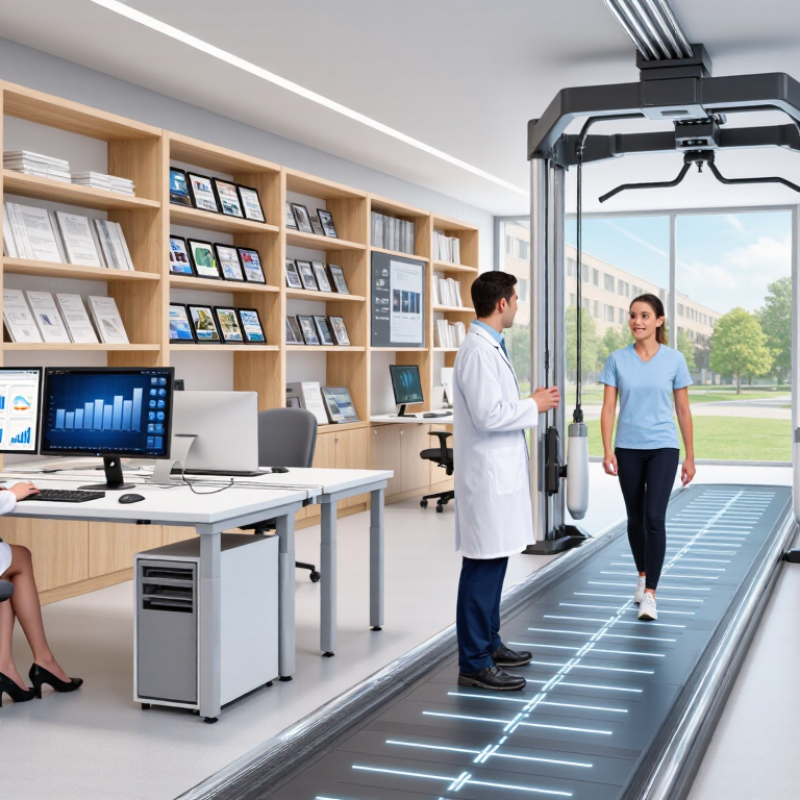
Instrumented walkway or pressure mat Depending on the system, may report walking speed, step and stride measures, cadence, and foot-pressure patterns. Check usable walking area, measurement zones, portability, surface requirements, repeatability, and export options. Walkway placement, standardized walking instructions, trial selection, and consistent handling of assistive devices. Surface and sensor care, software updates, technical support, and procedures for checking system function.
Force platform Ground-reaction forces and, in suitable configurations, center-of-pressure data during standing or movement tasks. Confirm platform dimensions, load capacity, sampling capability, installation requirements, synchronization, and analysis workflow. Safe testing procedures, task standardization, signal interpretation, and synchronization with other measurement systems. Installation and calibration guidance, service availability, software support, and secure data backup procedures.
Balance assessment system May measure postural sway, center-of-pressure behavior, or performance across defined balance conditions. Determine whether a force platform, pressure mat, or other sensor method fits the research question; review safety features and protocols. Standardized stance and task instructions, guarding procedures, consistent test conditions, and appropriate interpretation of results. Inspection and maintenance guidance, software support, and access to protocol documentation.
Patient-reported outcome measures Self-reported function, symptoms, activity, or participation, using validated questionnaires where available. Check population and language suitability, permissions or licensing, administration format, scoring rules, and whether electronic use is supported. Consistent administration, handling of incomplete responses, scoring, and explanation of what each measure can and cannot indicate. Access to current measure documentation, scoring guidance, translation information, and version-control procedures.
Research data capture and management software Structured study records, assessment results, data validation rules, audit trails, and exports, depending on the platform. Review access controls, data export, interoperability, backup arrangements, privacy requirements, and total costs for setup and maintenance. Study-form design, user permissions, data entry conventions, validation, and secure handling of participant information. Technical support, security and software updates, backup and recovery procedures, and help with migration or export.