Why Is Rehabilitation Training Important for Recovery?
Recovery rarely follows a straight line. A repaired knee may still feel stiff when someone steps off a curb. After a stroke, lifting a cup can take patience, repetition, and help. Rehabilitation training turns these everyday tasks into purposeful practice. It can rebuild strength, balance, coordination, and confidence while helping people regain useful skills.
Dr. Julie K. Silver, a physiatrist and rehabilitation researcher, is a relevant expert voice in recovery care. To avoid misattributing a quotation, this article uses an original guiding line rather than presenting invented words as hers: “Train for function, progress with care, and adapt to the person.” That principle reflects a key point: a plan should match someone’s health, goals, and changing abilities. Progress may be gradual. Some days are harder.
Rehabilitation Training Guidance helps explain how structured practice supports recovery and why qualified professionals matter. A therapist might adjust an exercise when pain rises, fatigue changes a person’s movement, or balance feels uncertain. Small details count: the height of a chair, the grip on a handrail, or the number of steps completed safely. Training is not simply pushing harder. It is choosing an appropriate challenge, noticing the body’s response, and adapting when needed. Results differ from person to person, and not every setback has an easy explanation. That deserves honest attention. This article explores how rehabilitation training can support safer movement, greater independence, and meaningful progress—without promising a quick or identical recovery for everyone.
What Rehabilitation Training Involves During Recovery
Rehabilitation training turns recovery goals into practiced actions. A clinician usually begins by checking strength, balance, pain, mobility, and everyday needs. Together, they set measurable targets, such as standing from a chair safely or climbing three steps. The plan may combine guided movement, repeated task practice, and advice on pacing. Small steps matter. The World Health Organization estimates that 2.4 billion people worldwide live with conditions that may benefit from rehabilitation (WHO, Rehabilitation fact sheet, 2023).
Sessions should match the injury, surgery, or health condition, not follow a generic routine. A therapist might adjust walking practice after observing a person’s stride, then add resistance as control improves. Training can also cover dressing, transfers, home exercises, and safe use of mobility aids. Progress varies. Pain, fatigue, and confidence can change from day to day, so clinicians monitor responses and adapt the workload. A plan may look tidy on paper; recovery rarely does.
Practice between appointments often matters, too. Short, regular exercises can help carry new skills into daily life, but technique and dosage should follow professional guidance. The WHO reports that more than half of people in some low- and middle-income countries who need rehabilitation do not receive it (WHO, Rehabilitation fact sheet, 2023). Access differs, and even a well-designed program may need revision when symptoms or circumstances change.
How Rehabilitation Training Restores Strength and Function
Rehabilitation training helps the body rebuild strength through movements that matter in daily life.
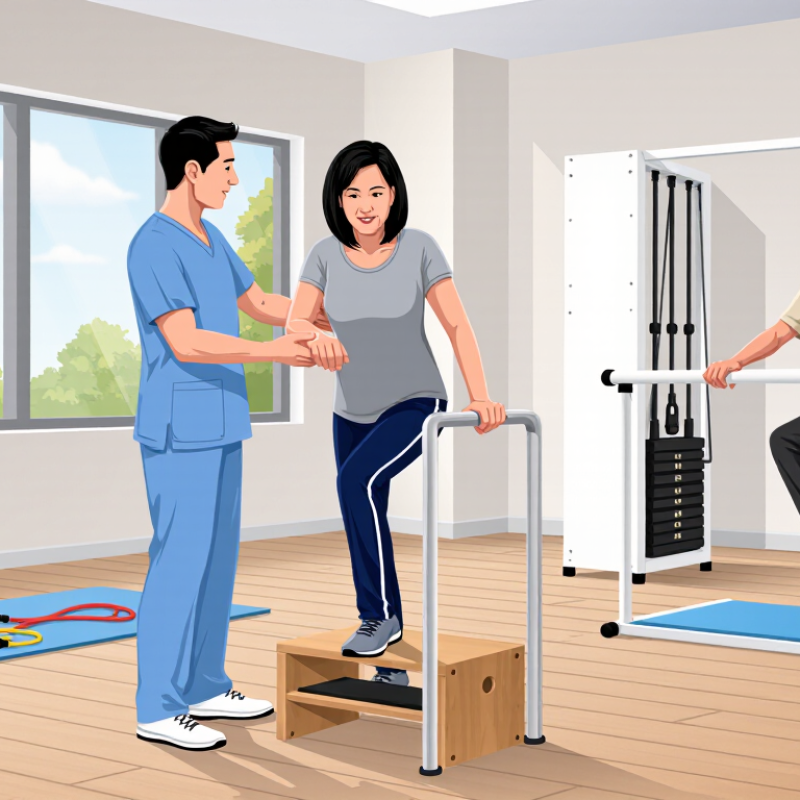
After an injury or operation, muscles may weaken, joints can feel stiff, and balance may change. A rehabilitation professional can assess these limits and choose exercises suited to a person’s needs. A session might include standing from a firm chair, stepping onto a low platform, or reaching for a shelf. These are not just drills; they rehearse useful tasks.
Small gains count. With steady practice, movements can become smoother and require less effort.
Progress usually comes from gradually adjusting repetitions, resistance, or task difficulty—not pushing through every discomfort. A therapist may watch how a knee tracks during a step or whether someone shifts weight away from a sore side. That detail can guide safer practice. Rest matters too.
Recovery is rarely a straight line, and a difficult day does not erase earlier gains. It can be frustrating when a simple movement still feels awkward. Tracking practical changes, such as walking farther or carrying a light bag with better control, can make progress easier to notice.
Pain and fatigue should be discussed with a qualified clinician, especially if they worsen or feel unusual.
Physical and Cognitive Benefits of Rehabilitation
Rehabilitation training can help restore strength, balance, and everyday movement after illness or injury. A therapist may guide someone through standing from a chair, walking across a room, or lifting a light object safely. Repeating these tasks can build coordination and endurance while helping people practice movements they need at home. The right pace depends on the person’s condition, symptoms, and clinical guidance.
Small steps count. Cognitive rehabilitation can also support attention, memory, planning, and problem-solving. Someone might practice following a short recipe, remembering a three-item list, or completing a familiar task with fewer prompts. These exercises connect thinking skills to ordinary routines, rather than treating them as abstract puzzles. Physical and cognitive work may overlap: walking while naming objects, for instance, asks the body and mind to cooperate.
Progress is rarely a straight line. Some days stall. Fatigue, pain, or frustration can make a familiar exercise feel surprisingly difficult, and a plan may need adjustment with a qualified clinician. Improvements can be subtle, such as needing less support to dress or keeping track of an appointment without a reminder. Those changes matter, though they do not guarantee the same outcome for everyone. A brief rest, a safer setup, or a smaller task can sometimes make practice more manageable.
Why Is Rehabilitation Training Important for Recovery? - Physical and Cognitive Benefits of Rehabilitation
| Recovery Area |
What Rehabilitation May Address |
How Progress Can Be Measured |
Potential Benefit in Daily Life |
| Mobility and walking |
Gait, balance, coordination, transfers, and safe movement practice tailored to a person’s condition and abilities. |
Walking speed or distance, observed walking safety, transfer ability, and assistance needed for mobility. |
May support safer movement at home and in the community and greater independence with daily activities. |
| Strength and physical endurance |
Progressive, appropriately supervised strengthening and activity training. |
Functional tasks such as repeated sit-to-stands, strength testing, and tolerance for activity. |
May make tasks such as standing, climbing stairs, and carrying out household activities easier. |
| Self-care and everyday function |
Practice of personally relevant tasks, such as dressing, bathing, eating, and using household objects; adaptive strategies may be included. |
Level of assistance required and ability to complete selected daily activities safely. |
Can help a person regain skills or find practical ways to perform activities more independently. |
| Thinking and attention |
Assessment and practice targeting cognitive difficulties, which may include attention, processing, planning, or problem-solving. |
Standardized cognitive assessment, task performance, and the person’s ability to use skills in everyday situations. |
May help people develop strategies for managing cognitive challenges during daily routines. |
| Memory and organization |
Memory strategies, structured routines, reminders, and practice of relevant everyday tasks. |
Recall of information or steps in a task, use of compensatory aids, and completion of planned activities. |
May support remembering appointments, following routines, and completing multistep activities. |
| Communication and participation |
Where appropriate, therapy may address communication, social interaction, and participation in meaningful activities. |
Ability to communicate needs and take part in selected home, community, or social activities. |
May help people participate more fully in relationships and everyday life. |
| Confidence and self-management |
Education, goal setting, pacing, and supported practice of activities relevant to recovery. |
Progress toward agreed goals, confidence with selected activities, and ability to follow a suitable self-management plan. |
May help people take a more active role in recovery and adapt activities to their abilities. |
Important: Rehabilitation is individualized. Benefits and recovery timelines vary according to the person’s health condition, goals, environment, and access to appropriate care. Progress measures should be selected by qualified clinicians and interpreted in context.
Source: World Health Organization, Rehabilitation.
Common Types of Rehabilitation Training
Rehabilitation training helps people rebuild useful abilities after illness, injury, surgery, or a change in health. The right approach depends on a person’s goals, symptoms, and medical guidance. Progress is rarely tidy. A movement that feels simple at home may be difficult in a clinic, and recovery can vary from day to day.
Common types include physical therapy, which may use walking practice, balance exercises, gentle strengthening, or joint movement. Occupational therapy focuses on everyday tasks, such as getting dressed, preparing a meal, or gripping a cup. Speech and language therapy can support communication and swallowing after certain health conditions. Some people also receive cardiac or pulmonary rehabilitation, with supervised activity and education to improve safe exercise habits. These approaches are not interchangeable; a qualified clinician can recommend what fits.
Tips: Set small, practical goals, such as standing from a chair with less help. Follow your care team’s instructions, and stop to ask if pain, dizziness, or unusual shortness of breath occurs. Keep a simple progress note. It may reveal patterns you otherwise miss.
Factors That Shape Rehabilitation Plans and Progress
Why Is Rehabilitation Training Important for Recovery?
Factors That Shape Rehabilitation Plans and Progress
Rehabilitation works best when training fits the person, not just the diagnosis. The World Health Organization estimates that 2.4 billion people live with conditions that may benefit from rehabilitation (WHO, Rehabilitation fact sheet, 2023). Yet recovery varies. A knee injury, stroke, or chronic pain may require different exercises, pacing, and support. Clinicians consider movement, strength, pain, medical history, daily tasks, and personal goals before setting a plan.
Progress also depends on sleep, confidence, transport, family support, and access to regular care. A person who struggles to reach a clinic may need practical home exercises. Small changes matter: a steadier step, easier buttoning, or less fatigue while cooking. Progress is rarely a straight line. Some plans need adjustment, and a missed session does not erase earlier gains. I would be cautious about judging success by one test or one difficult day; both can give an incomplete picture.
Tips: Write down one daily task that feels hard, such as climbing stairs. Ask your rehabilitation professional how to practice it safely, and when to pause. Track changes weekly, not hourly.